

Choosing the right Zoho partner comes down to fit, not tier badges: pick the consultant who maps your workflows before touching the software, has delivered projects like yours, and stays on after go-live. In Singapore, one factor is easy to overlook and matters more than most: make sure the partner has a real Singapore-based client-facing team, the people who run your consultation and support, rather than only a local-sounding name with everything routed offshore. A Singapore-based team gives you same-timezone responses, on-the-ground knowledge of how local SMEs operate, and someone you can meet when a project needs it. The Zoho partner directory lists three tiers (Authorized, Advanced, Premium), but the tier tells you about scale, not whether a firm is right for your business.
This guide walks through what a Zoho implementation partner actually does, how to read the partner tiers, the exact questions to ask on a discovery call, how pricing works, why local matters, and the red flags that signal a rushed rollout. We have implemented Zoho for more than 300 businesses across 20+ industries since 2018 as a Preferred Zoho Partner in Singapore, so the advice here reflects what tends to separate a system your team adopts from one that quietly dies in a month.
If you would rather map that out with someone who has done it before, you can book a free consultation with our Zoho team and get a candid read on what your project needs before you commit to anyone.
Most botched Zoho projects do not fail because the software is weak. They fail because the setup never matched how the team actually works. The CRM goes live, the sales reps keep their pipeline in their inbox, and six months later nobody trusts the data. Zoho spans more than 55 connected apps, so a partner who installs the defaults and hands over the login leaves you with disconnected modules and automations that break the first time a process changes.
The cost of getting this wrong is real. You pay twice when a second partner has to unpick the first one’s work, and you lose months of momentum while your team drifts back to spreadsheets. Industry buyer guides on choosing a CRM implementation partner make the same point: the partner decision shapes adoption and return more than the product choice itself. For a Singapore SME, the right partner also understands local practices and the grant landscape, which an overseas contractor usually does not.
A Zoho implementation partner is a certified consulting firm that configures Zoho around your business, not the other way round. Reselling a licence is the smallest part of it. The real work is discovery, configuration, data migration, integration, training, and support. A good partner behaves like an extension of your team rather than an order-taker who ships a template.
A capable ZOHO CRM 咨詢與導入 partner typically handles:
This is where the article earns its keep, because the honest answer is that the highest tier is not automatically the best choice for you. Zoho’s partner programme has three public tiers, and each is earned through an annual scoring process, not bought.
Zoho ranks consulting partners into three tiers, Authorized, Advanced, and Premium, based on certifications, revenue, implementation success, and customer satisfaction. Authorized is the entry tier, suited to clean, straightforward setups. Advanced partners handle multi-app deployments and automation. Premium is the top public tier, built for larger and more complex projects. The practical rule: match the tier to your project size, then judge the actual fit. An experienced Advanced partner with relevant industry knowledge often gives a mid-sized SME more attention than a Premium firm whose bench is split across enterprise accounts.
One quick verification step matters. Search the firm on Zoho’s official Find a Partner directory, and read the tier listed there. If a firm is not in the directory, it is not a current Zoho partner, whatever badge sits on its homepage.
On a discovery call, the answers to these tell you more than any tier badge:
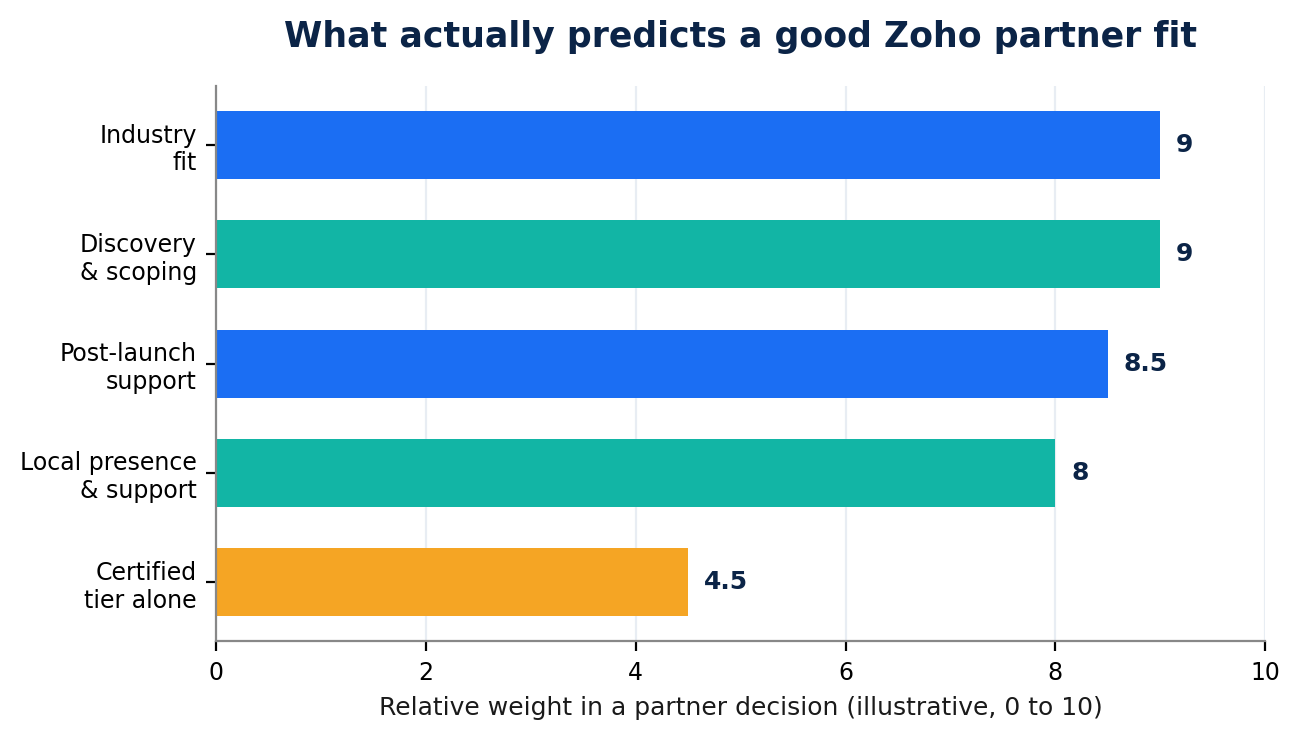
Weighing those factors, here is roughly how the decision should be balanced. Tier alone should carry the least weight.
Not everyone selling Zoho does the same job. The difference matters when adoption and long-term support are on the line.
Provider type | What they mainly do | Best when |
|---|---|---|
Certified implementation partner | Discovery, configuration, migration, integration, training, ongoing support | You want a system built around your workflows and supported long-term |
Reseller | Primarily sells Zoho licences, limited setup | You already know exactly what you need and can self-implement |
General CRM consultant | Broad CRM advice, may lack Zoho certification | You want platform-agnostic strategy, not hands-on Zoho build |
A Zoho implementation has two cost layers: the Zoho licence (per user, per month, billed by Zoho) and the partner’s implementation fee (a one-off project cost for scoping, configuration, migration, and training, sometimes with an ongoing support retainer). We avoid quoting fixed figures here because they depend on user count, data complexity, the number of apps, and how much customisation you need. Any partner who quotes a firm price before understanding your workflows is guessing.
The licence side is worth understanding before you talk to anyone, because it shapes the whole budget. You can start a free trial to see the interface and pricing tiers for yourself: the Zoho CRM sign-up is here, and for very small teams that want something lighter, the Bigin by Zoho sign-up is here. A good partner will help you pick between them based on team size and process complexity rather than pushing the most expensive plan by default.
Not sure which licence tier fits or what a realistic scope looks like? You can get a free CRM assessment for your business, and where it helps, we often start with a proof-of-concept so you can see your own data in a working system before committing to a full build.
A realistic Zoho rollout is a sequence, not a switch you flip. Discovery and scoping come first, then configuration and migration, then testing, training, and a phased go-live. Timelines vary with complexity, but the pattern that predicts success is consistent: configure to the team’s real process, train by role, and plan for a support window after launch when the questions actually surface.
Adoption is the part most projects underinvest in. A system nobody uses is worse than the spreadsheets it replaced, because now the data lives in two half-updated places. Our engagement model is built around that risk: a consultation to scope the problem, an optional proof-of-concept so you see it working on your own data, then implementation, or a Do-It-With-You (DIWY) programme where we build alongside your team so the knowledge stays in-house. You can see how this played out in our customised CRM success story for a real estate agency, where the system was shaped around how the agents actually worked rather than a generic template.
A partner with a real presence in Singapore brings advantages that are easy to underrate until a project is mid-flight. What matters most is where your client-facing team sits: the people who scope the project, run your consultations, and answer support requests. When that team is based in Singapore, you get same-timezone responses, on-the-ground familiarity with local compliance such as GST and grant application, and someone you can actually sit down with when a project needs it. Delivery and development can sensibly draw on a wider regional team, that is common and often keeps costs sensible, but your point of contact, consultation, and support should be local. The firms to be wary of are the ones with only a local-sounding name and no Singapore presence at all: no local consultation, no local support, everything routed offshore. Ask who will own your account here, and where your support requests are answered.
For context on our standing: Zolution is a Preferred Partner of Zoho in Singapore and was named Zoho APAC Partner of the Year 2022, and our consultants hold various Zoho certifications. Zolution is headquartered in Singapore, with local client-facing consultation and support here, backed by a regional delivery team that handles build and development. We reference that as evidence of track record, not as a reason on its own to pick us, because the fit questions above still matter more than any badge. If you work in a regulated space such as financial services, our CRM strategy and risk assessment guidance, and a broader view in our Zoho CRM guide for SMEs, are useful starting points before you shortlist anyone.
When you are ready to compare notes, our team is reachable through our contact page, and we are happy to point you to reference projects in your industry.
The right Zoho partner is the one who maps your workflows before building, has delivered projects like yours, and supports you after go-live, not simply the highest-tier firm in the directory. For Singapore SMEs, a partner with a Singapore-based client-facing team adds same-timezone consultation and support that a name-only presence cannot match. Vet on fit and post-launch support, confirm your point of contact and support are local, verify the firm on Zoho’s official directory, and treat certified tier as the weakest signal in the decision.
A Zoho partner is a certified consulting firm that configures Zoho around your business, covering discovery, setup, data migration, integration, training, and ongoing support. Reselling the licence is a small part; the real value is building a system your team actually adopts.
Zoho has three consulting-partner tiers: Authorized (entry level), Advanced (multi-app and automation work), and Premium (larger, complex projects). Tiers are earned through an annual scoring process, not purchased, and reflect scale and experience rather than fit for your specific business.
No. Premium suits large, complex deployments, but an experienced Advanced or Authorized partner with relevant industry knowledge often gives a mid-sized SME more attention and a better-fitting build. Match the tier to project size, then judge the actual fit.
Cost has two parts: the per-user Zoho licence billed by Zoho, and the partner’s one-off implementation fee for scoping, configuration, migration, and training. The total depends on user count, data complexity, apps, and customisation, so a credible partner scopes before quoting.
Bigin is Zoho’s lighter, simpler pipeline tool aimed at very small teams, while Zoho CRM suits businesses that need deeper automation, customisation, and multi-app connectivity. Start a free trial of each to compare, and let a partner advise based on your team size and process complexity.
Search the firm on Zoho’s official Find a Partner directory and check the tier listed there. If the firm is not in the directory, it is not a current Zoho partner regardless of the badge on its website. Then ask for the certifications of the specific consultants assigned to your project.
What matters is a Singapore-based client-facing team, the people who run your consultation and answer support requests, since same-timezone responses and local familiarity with GST and grant applications matter most during rollout and support. Build and development can draw on a regional delivery team, which is common; the risk to avoid is a firm with only a local-sounding name and no Singapore presence, so confirm who owns your account here and where support is answered.
Watch for partners who skip discovery, promise plug-and-play installs, cannot show relevant industry work, give vague answers on methodology or QA, or leave post-launch support undefined. Any of these signals a rushed rollout you may pay to redo later.
If you want to map the shortest path from where you are now to a Zoho system your team will actually use, you can talk to a Singapore-based Zoho consultant. We will give you an honest read on scope, fit, and licence choice, from a Singapore-based consulting team, with no obligation to proceed.
A Note on Pricing and Eligibility: Zoho licence tiers, product features, and pricing are set by Zoho and can change over time. Confirm current terms on Zoho’s official site before making a purchase decision. This article is for general information and is not financial or procurement advice.