

Zoho CRM vs Custom System: The Smarter Build vs Buy CRM Decision
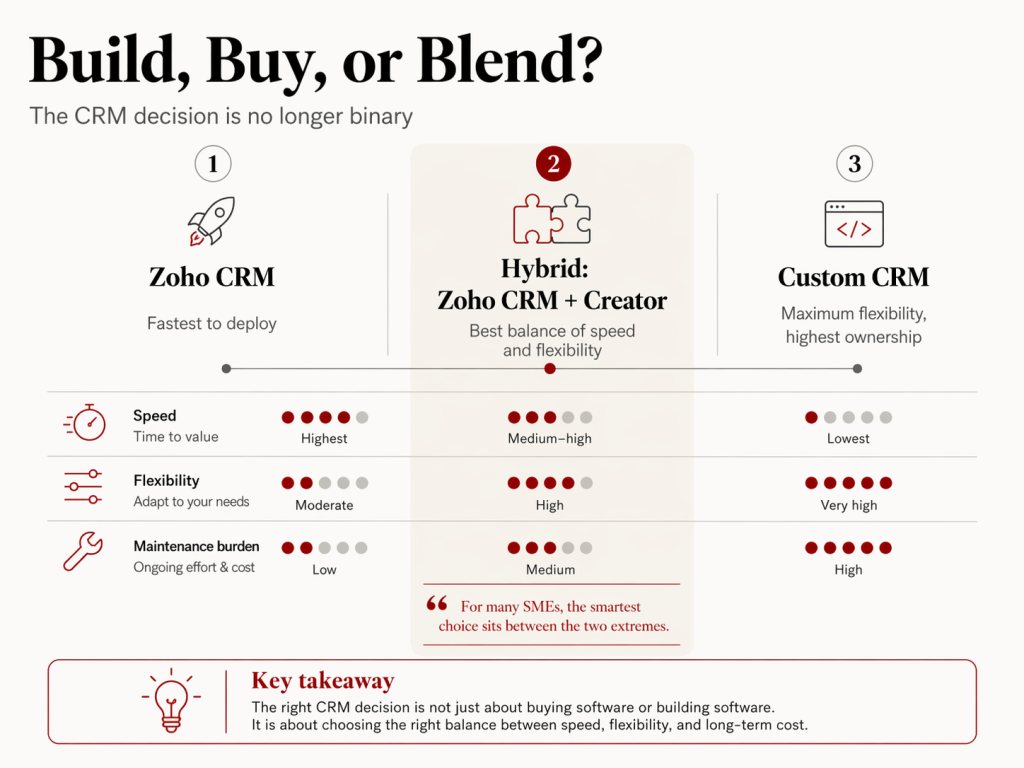
Most companies think the CRM decision is a simple choice between buying software and building software. That framing is incomplete.
The real question is this: how do you get the control and flexibility the business needs without creating unnecessary delivery risk, cost, and long-term maintenance burden?
That is why the discussion around Zoho CRM vs custom CRM should not start with only two options. In practice, there are three.
The first is to use Zoho CRM as the core platform. The second is to build a fully custom system. The third, and often the most practical, is a hybrid model where Zoho CRM handles the standard customer and sales functions, while Zoho Creator supports the workflows that are genuinely unique.
For many growing businesses, that hybrid model is where the decision becomes more commercially sensible.
The Three Approaches
Zoho CRM is the right fit when the business needs a proven platform for leads, contacts, pipeline management, reporting, activities, and workflow automation. It is designed to be configured, not built from scratch, which usually means faster deployment and lower delivery risk.
A custom CRM system is built specifically for one business. This gives the highest level of freedom, but it also creates the highest ownership burden. Every major change, enhancement, integration, report, and support issue becomes the company’s responsibility, whether internally or through a vendor.
The hybrid model sits in the middle. Zoho CRM remains the core system for customer-facing data and management visibility. Zoho Creator is then used to build the operational workflows, internal tools, or mobile applications that are too specific to fit comfortably inside standard CRM structures. The two systems work together as one connected solution.
Why the Hybrid Model Deserves Attention
Many business processes are only partly unique.
The customer and sales layer is often fairly standard. Most companies need contact management, lead tracking, quotation follow-up, activity control, dashboards, and reporting. Rebuilding all of that through custom development is usually poor use of budget.
The operational layer, however, is often where real complexity appears. This may include site work, internal processing, service fulfilment, equipment tracking, approval workflows, booking logic, or specialised data capture.
A hybrid architecture allows the business to keep the CRM standard where standardisation is useful, while introducing custom applications only where flexibility is genuinely needed.
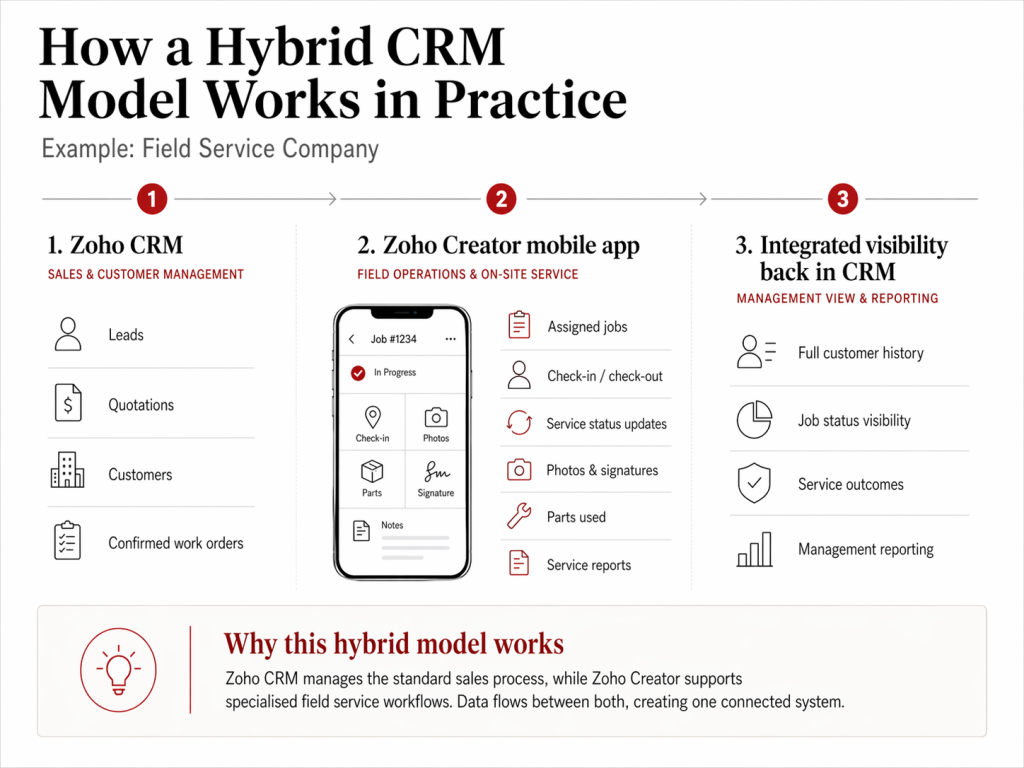
A simple example is a field service company. The sales team uses Zoho CRM to manage prospects, quotations, customers, and confirmed work orders. Once a job is won, a custom mobile app built in Zoho Creator is used by field engineers to view assigned jobs, record site visits, update service status, capture photos, log parts used, and submit service reports on-site. That operational data then flows back into Zoho CRM, so management still has a complete view of the customer, the order, and the service outcome in one integrated system.
This is the main benefit of the hybrid model. The business does not need to force its operational process into a standard CRM, and it also does not need to build an entire platform from scratch just to support one specialised workflow.
When Zoho CRM Works Best
Zoho CRM is usually the strongest choice when the business needs speed, structure, and visibility. It works well when the company’s main problem is not lack of software flexibility, but lack of process discipline, reporting, and control.
If the sales process is broadly conventional, and the goal is to improve pipeline management, follow-up, automation, and management reporting, a standard CRM platform is usually the most efficient answer.
When Custom CRM Is Really Required
A custom system becomes more justifiable when the business model itself is highly specialised. This may involve unusual pricing logic, proprietary workflows, complex case handling, deep compliance requirements, or service models that cannot be handled sensibly through configuration and extensions.
Even then, custom development should be approached with caution. The flexibility is real, but so is the long-term burden. A custom CRM is not just a project. It is an ongoing ownership commitment.
Cost and Scalability: The Real Trade-Off
The biggest mistake in the build vs buy CRM discussion is focusing only on initial cost.
The real issue is total cost of ownership over time. That includes change requests, bug fixing, technical support, integration maintenance, user adoption issues, reporting enhancement, and dependency on specific developers or vendors.
This is where many businesses underestimate the true cost of custom systems. The initial build may look justified, but the long-term maintenance model is often much heavier than expected.
Zoho CRM usually offers the best cost control when requirements are mostly standard. Hybrid architecture often offers the best balance when the business needs some operational flexibility without taking on the full burden of custom development. Custom CRM can scale well too, but only when it is properly architected and supported with strong long-term governance.
Zolution’s Recommendation Model
At Zolution, our recommendation is usually based on one simple principle: standardise what should be standard, and customise only where it creates real value.
If the requirement is mostly conventional, start with Zoho CRM. If there are selected operational workflows that need more flexibility, extend the solution with Zoho Creator. Only move toward a full custom system when the business model is genuinely too specialised for the first two options.
That approach usually gives clients a better balance between speed, flexibility, scalability, and commercial practicality.
Frequently Asked Questions
- Is Zoho CRM cheaper than custom CRM? Usually yes, especially once maintenance, upgrades, and implementation speed are taken into account.
- When is the hybrid model better than Zoho CRM alone? When the business has a mostly standard CRM requirement, but also has specific operational workflows that need custom forms, mobile tools, or process logic.
- Is hybrid architecture harder to manage? It is more complex than using Zoho CRM alone, but usually far more manageable than building a full custom CRM from scratch.
- When should a company avoid custom CRM? When requirements are still evolving, internal ownership is weak, or the business mainly needs execution discipline rather than full software differentiation.
- What does Zolution usually recommend? In most SME cases, either Zoho CRM alone or a hybrid Zoho CRM plus Creator approach is the most commercially sensible path.